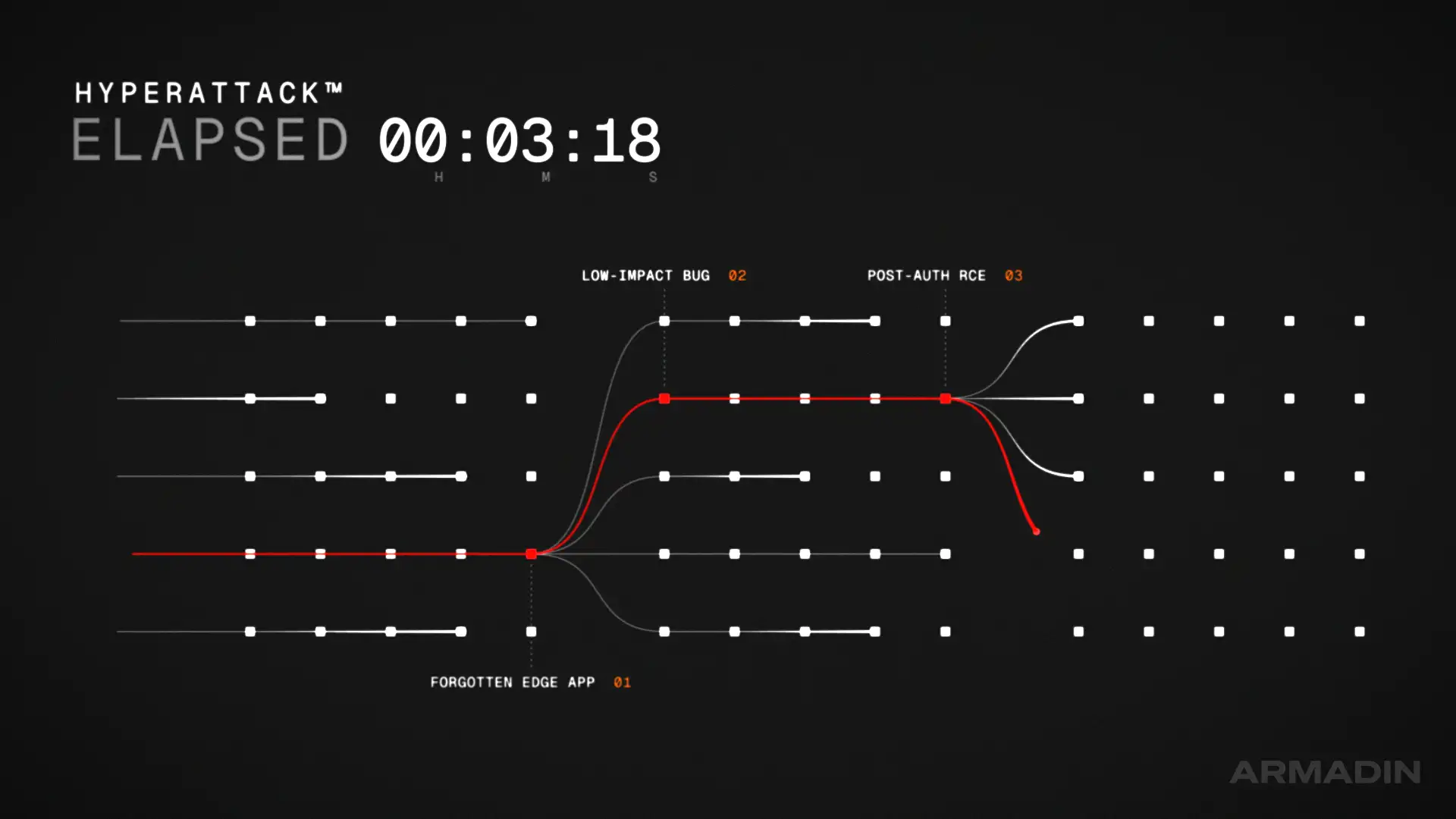
Many dangerous vulnerabilities don’t start with a critical alert. They begin with something fairly common or get flagged as low severity. In the latest “Kill Chains and Coffee” video, I joined my colleague Greg Heon to trace through a kill chain we found during a recent engagement with a global Fortune 500 client.
We began the engagement by unleashing an agentic Hyperattack™ with AI autonomously attacking a defined environment at machine speed. The engagement resulted in full administrative control over a production AWS account.
The kill chain started with something a traditional scanning tool would likely flag then move into a backlog. A web application exposed a directory listing to the Internet without requiring authentication. This web application was running GeoServer, an open source mapping platform.
But the Hyperattack flagged something interesting: the server accepted HTTP PUT requests, meaning files could be uploaded to the directory.
Armadin pointed an AI agent at GeoServer’s public source code to conduct a security review. It found that GeoServer’s map pinning functionality supported Apache FreeMarker templates, which are designed to set placeholders for items like addresses or coordinates. The templates are loaded when a user clicks on them. However, Apache FreeMarker also allows the execution of arbitrary Java code inside a Java Virtual Machine (JVM).
We then crafted a malicious FreeMarker template to fetch environment variables, uploaded it via a PUT request to a map coordinate, and triggered execution by “clicking” that point on the map. That led directly to us accessing live AWS access keys, secret keys, and session tokens.
The keys belonged to an AWS role with full permissions to all resources in the production AWS account, meaning full compromise of the account.
Enterprise security teams are feeling overwhelmed by AI threats. They don’t need false positives, an endless string of alerts, or more CVEs to chase down. They need verified proof of their exploitable risk, along with guidance on how to fix it.
This particular kill chain would often be overlooked by traditional manual pentests. With machine-speed discovery and red team tradecraft, Hyperattack agents were key to transforming a low-severity observation into a critical kill chain.
This is exactly the type of threat landscape the security industry needs to worry about today: agentic attackers operating at machine speed, depth, and scale. That’s why it’s so critical to pressure-test your own environment just like an adversary would.
After showing critical impact, Armadin and the client worked to remediate the issue at the pace of a live incident. The timeline for finding and fixing the kill chain was extremely accelerated:
From my experience, the speed of this engagement wasn’t an outlier. This is the new norm. These high-impact kill chains prove real impact to our clients, and they treat them as critical security incidents.
Discover the value of an agentic Hyperattack. Request a demo today.