Every major shift in technology hands adversaries a new opportunity. Since my first days at the Pentagon, and later at Mandiant, I've responded to intrusions through the rise of the web, cloud, and mobile. None of those shifts moved as fast as the AI shift.
AI expands what adversaries can do in scale, scope, and effectiveness. Campaigns run faster and broader than any human. They adjust without being instructed. They put elite tradecraft in the hands of people who never earned it.
Earlier this year, the conversation centered on Mythos, a frontier model whose skill at uncovering and weaponizing flaws forced the industry to confront what top-tier AI could do in the wrong hands. Access to that capability was tightly controlled.
ARTEX is the other side of the coin. Published on GitHub in July as an open-source red-team framework, it wires agentic workflows to whatever large language model an operator chooses, commercial or open-weight. Within weeks, criminal and state-aligned crews had turned it against real targets. The FBI issued a FLASH alert about it on November 13. Researchers have counted well over a thousand internet-exposed ARTEX consoles. In October, the developer pulled ARTEX off GitHub. It did not matter, as copies were already out there, and they still are.
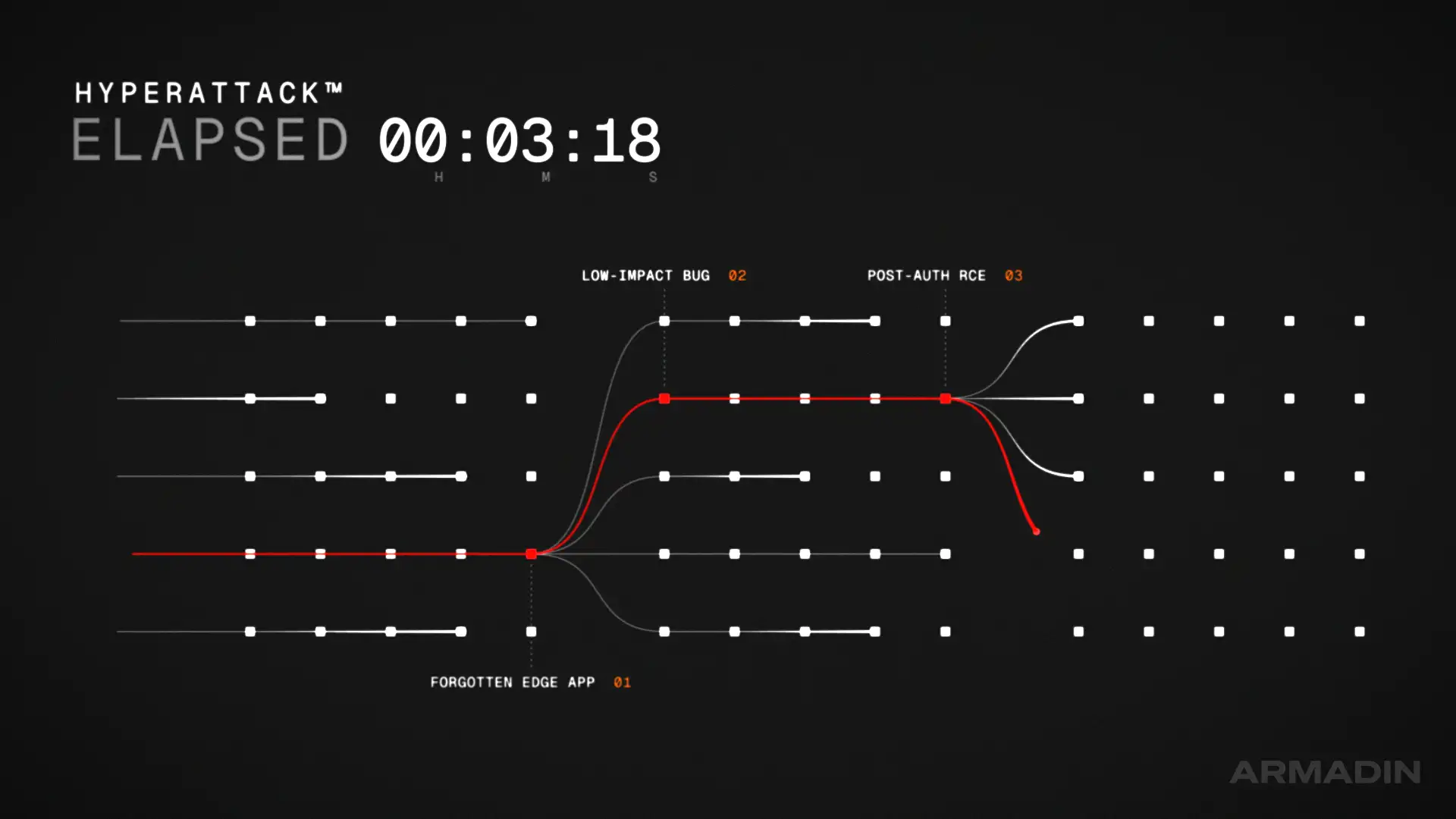
Here's the moment - machine-speed intrusion no longer requires a frontier lab's model. It requires a free framework, an API key, and a target list. The reporting so far shows ARTEX operators winning with fundamentals, not exotic zero-days. Adversaries are winning with leaked credentials, password spraying, and unpatched web-application flaws, worked tirelessly and at scale.
Across espionage, extortion, sabotage, and destruction, AI will overtake humans at performing offensive operations in the cyber domain. ARTEX shows that for several stages of an intrusion, that moment has already arrived.
We are in a transition phase. On one side, AI-powered offense is already loose. On the other is a future where AI continuously probes our environments and adjusts our protections against everything it uncovers. We are not there yet. There is no auto-remediate with a compensating control yet, but it is coming. Until then, priority one is using AI to learn the reality of where we stand.
Here is the game plan I would run:
Waiting is a decision, and it is the wrong one. ARTEX turned AI-driven intrusion from a lab demonstration into a commodity. Every new model release makes these operations faster, cheaper, and more precise.
My first move would be to charter an AI security readiness program this week, with the CEO briefed and behind it. One accountable executive. Real funding. People from the security, infrastructure, engineering, and identity teams in the same room. The organizations that mobilize first build institutional muscle memory that compounds with every iteration.
Next, I'd commission a full AI-led sweep of every asset reachable from the internet, looking for published CVEs, flaws on CISA's Known Exploited list, custom-code weaknesses unique to the company's applications, and its credentials being traded in criminal markets.
In the CISO chair, I'd bring in an AI-native firm to test every route through the perimeter. Picture several AI models working in parallel under human supervision, relentlessly probing every internet-connected system the company owns.
In practice, every public-facing app and service gets scrutinized by capable models alongside seasoned operators. I would want access to whichever frontier model is strongest now. Leadership among models changes constantly, and different models excel at different stages of an intrusion. A testing platform that is not tied to one model keeps the best weapon in the defender's hand. ARTEX operators already work this way, switching models the moment one balks or a better one ships.
That first sweep also draws an accurate map of what an organization actually exposes. Nearly every enterprise I have seen undercounts its internet-facing footprint: abandoned test servers, cloud workloads nobody owns, and partner connections granted trust by default. AI-led discovery exposes what spreadsheets and CMDBs miss, before an ARTEX-equipped attacker does. Authentication endpoints deserve special attention. Login portals, VPNs, SSO pages, and APIs that accept passwords are the doors ARTEX campaigns knock on first.
For the first several weeks, I would consider standing up a war room that connects the AI attackers directly to the engineers responsible for remediation.
Here's the trap. Dumping hundreds of results into a ticketing queue closes nothing. It frustrates engineers and buries the urgency each exposure carries. What works is a dedicated remediation cell: findings reviewed as they arrive, ranked by how easily they can be exploited and what they'd cost the business, and handed to named owners with firm deadlines and an escalation path.
I would change the scoreboard too. Counting closed tickets or average patch time tells you little when AI can link several modest weaknesses into a single attack path no analyst predicted. The number that matters is how many exploitable routes into the environment remain, confirmed by attacking again rather than by a ticket's status. That takes a platform built for the full cycle: expose, prove, remediate, re-test.
Beyond the initial sprint, the goal is a standing exposure-management capability. Not an annual or quarterly penetration test, but an ongoing offensive effort that proves defensive effectiveness or trains the defense.
With the perimeter effort moving, I would point the same AI offensive capability inward, starting with four areas:
A. Business-critical applications. These are the systems the company depends on: ERP, customer portals, in-house tools, and anything handling regulated or confidential data. Models can examine business logic, login and session handling, and API endpoints with a depth and inventiveness no manual team can sustain across a large estate.
B. Assume they're already in. I would plan as if an intruder has a foothold today. AI-led exercises can model what happens after initial access: which systems are reachable, which data could be stolen, which operations could be halted, and how far an adversary could travel before anyone notices. These tests run continually, not once.
C. Identity. This means identity design, the paths that permit lateral movement, and every opportunity to escalate privilege. For most enterprises, identity is now the main battleground, and AI will relentlessly exploit weaknesses in Active Directory, cloud IAM roles, federation relationships, and sprawling service accounts that people tend to miss or push down the backlog. ARTEX raises the stakes here more than anywhere, because its documented campaigns lean heavily on stolen and sprayed credentials. Phishing-resistant MFA, rotation of exposed secrets, and throttling of login attempts are no longer hygiene items. They are frontline controls.
D. Production-stage testing for software makers. Companies that ship software are right to keep investing in secure development practices and fast patch delivery. I'd add testing on the right side of the lifecycle: platforms like Armadin that show a product the way an attacker sees it, under realistic production conditions. Bugs that slip past static analysis, dynamic scanning, and peer review are precisely the ones adversaries hunt. Right-side testing exposes and shields what earlier-stage controls let through.
Depending on how quickly teams can remediate, this work may run for months. Permanent remediation takes time, and the exposure doesn't wait for it. As AI agents uncover new attack paths, I'd put interim safeguards in place (blocking policies, detection logic, and automated response runbooks) to cover the exposure in the meantime. That's how you brave the gap.
Eventually, security teams will rely on systems that reason, learn, remember everything, and respond on their own to any custom exploit that offensive tools uncover. That's where this is heading.
We are not there yet. Until autonomous defenses are proven and trusted, it's all hands-on deck. People stay in the loop to eliminate exploitable risk while we design and train defensive AI around our own platforms, technology stacks, and threat profiles.
There's an uncomfortable reality in this transition phase. Attackers operate without governance, risk little when an attempt fails, and never wait on a change-approval board. ARTEX's own history proves it. A tool built for authorized testing was repurposed by hostile operators within weeks. Defenders have to plan and act across that imbalance now, knowing that today's discoveries, remediations, and lessons learned become the training material for the autonomous defenses that eventually protect us at scale.
For two decades at Mandiant, my teams showed up after the breach. We learned how attackers operated by studying what they left behind. That model worked for its era. It doesn't work when the attacker is a framework anyone can download.
Armadin is built to get there first. We run AI attacks safely and at scale in live environments, the way an ARTEX operator would, but under human supervision and training. Then we prove which attack paths are real, prioritize them, and keep closing the gap before anyone walks through it. Not a longer list of problems. The short list that matters, proven.
Mythos was the warning. ARTEX is the proof. Every CEO and CISO I talk to is asking the same question: are we actually secure? A compliance report can't answer it. Neither can last quarter's pen test. Only an attack can. Armadin Red runs that attack on your terms, before an adversary runs it on theirs so you are one step closer to preventive security vs being reactive. That is the future.