Greg Heon: One of my perceptions is that red teamers trying to break in through the infrastructure generally get in through social engineering. As someone who has run both traditional pentesting and Hyperattacks, what does that process look like at Armadin?
Nick McClendon: Previously, when you wanted to quickly get a corporate network foothold, the red team playbook was phishing. Now we typically start as an unauthenticated external attacker with a Hyperattack. The customer gives us the scope, we do some expansion to identify any other assets, and we confirm that with them. From there, we start with some relatively basic scanning, the things you would expect most pentests to do, but expand into agentic testing of interesting items through our targeting process.
GH: What do you typically find?
NM: We tend to target classes of software and other systems that are overprivileged but historically haven’t had any security budget allocated to them. With machine-speed Hyperattacks, we have a lot more time to pull interesting threads to get to network access and increase our impact.
GH: So you’re moving really fast by starting at the internet, finding a couple vulnerabilities, chaining them, and then you’re in the corporate network?
NM: With Hyperattacks, it’s been surprising the number of times that we’re getting external code execution and landing on Windows boxes connected to the corporate Active Directory network. No one has spent any time auditing these areas historically, so they just kind of sit around bridging external and internal, with no one securing them properly.
GH: From a defender’s perspective, this is obviously revealing a ton of findings and impact very quickly from an untrusted place. I think the amount of stuff that’s on the public internet, especially for large enterprises, is really growing. It’s a really big attack surface now, right?
NM: Yes. I think we’re now paying a reckoning for both the aggressive move to the cloud, where we kind of gave up our internal network boundaries too quickly, and then the outcome of a lot of people moving to work from home during COVID. We saw a massive push to make everything accessible, like companies trying to avoid using a VPN because it was a bad user experience. We’ve accumulated a decent amount of technical debt, and AI attackers will make you pay that debt off.
“We’ve accumulated a decent amount of technical debt, and the AI attackers will make you pay that debt off.”
GH: I think there’s something to that. To what extent are we chaining together vulnerabilities as we have these critical findings?
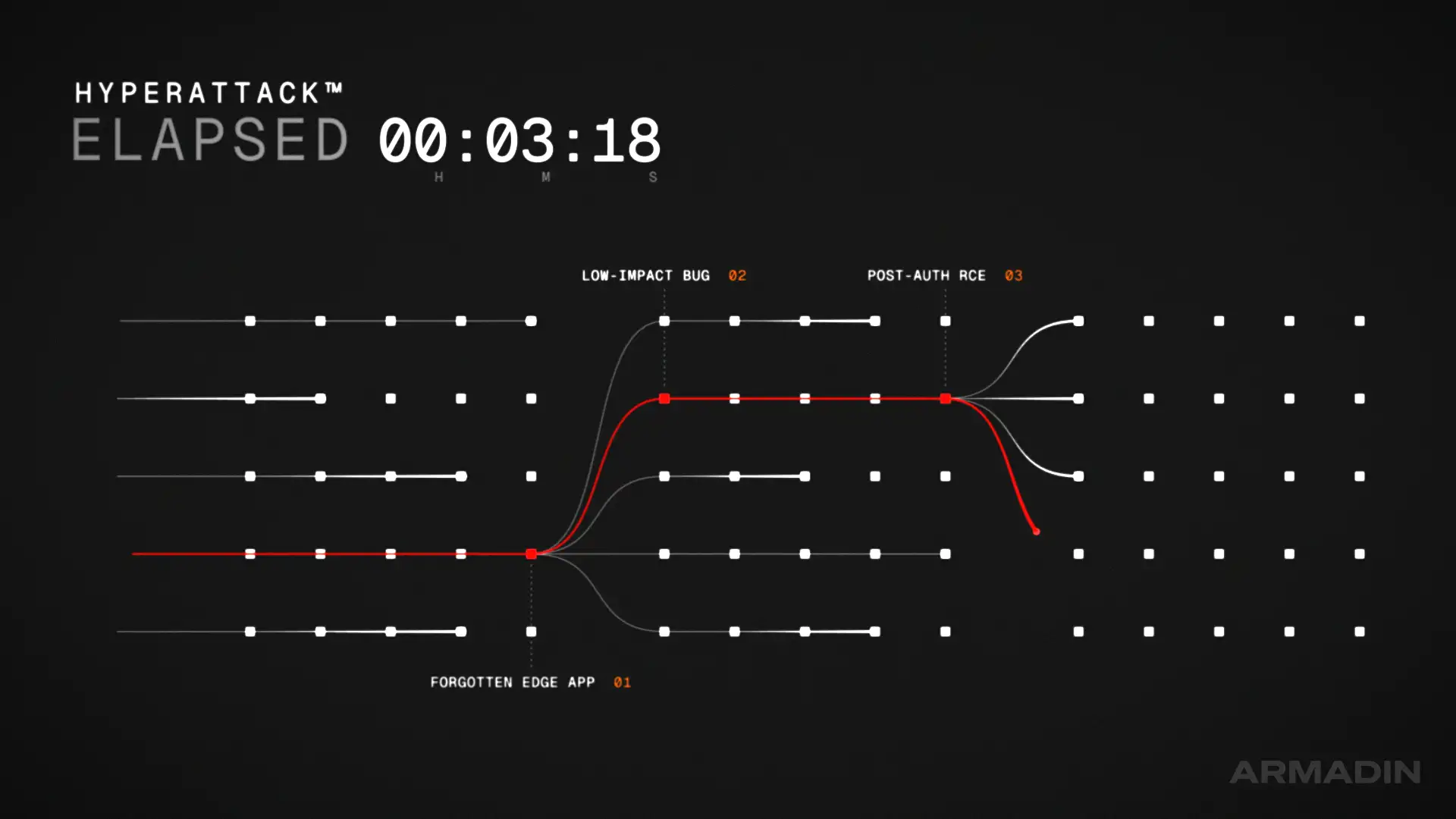
NM: For external access, we’re chaining vulnerabilities almost 100% of the time to form an actual kill chain. Normally we’re seeing what we would consider a lower-impact vulnerability. It doesn’t immediately drop you into the corporate network, but it drastically expands the attack surface of an application. And that’s where we’re seeing all these post-authentication or local server vulnerabilities that lead to code execution, sometimes by design and sometimes by a relatively simple logic bug.
GH: That’s where AI helps, right? AI can handle so much of what you’d expect from an external attack that you now have more time to investigate. Can you compare a pentest from a couple years ago to what you can do today?
NM: I think a big difference is the majority of external consulting engagements for large companies would be a web application assessment that’s hyper-focused on a first-party application developed by the company themselves. Maybe they have access to source code or are doing an application-specific analysis and trying to break in with these kinds of logic vulnerabilities.
The flip side would be an external pentest where likely none of that is happening. It encompasses the entire landscape, including third-party applications, and it would be a little bit of dealer’s choice from there, depending on the expertise of the tester.
By defining a minimum bar of quality for external pentests, that includes a lot of things that aren’t really worth spending human time on. When you get down to checking all the boxes to make sure a company is minimally secure, you have maybe eight or 16 hours to focus on things that are really interesting. And that’s not nearly enough time to evaluate a large company's footprint.
The fact that the majority of our work is now automated means as our internal AI attacker and human operators get better, we have a lot more time to dedicate to things that actually drive impact, not just compliance checkboxes.
“We have more time to dedicate to things that actually drive impact, not just compliance checkboxes.”
GH: What does that speedup look like for an external assessment, in the amount of human time you have to invest?
NM: If we were scoping a specific assessment of an application, standard consulting would probably be 80 hours. So two weeks with one person or one week for two people. That is not at all what we now spend on the same type of assessment. The total time is closer to ten or sixteen hours. It’s a drastic speedup when we launch our agentic Hyperattacks.
GH: Wow. So five to eight times faster today. And that doesn’t even include all the busy work that previously took more than half the time of an assessment. That doesn’t feel like anything that’s previously been available on the pentest or consulting side.
On the network side, I think historically it’s been much more of a check-the-box pentest for most companies. If you have 10,000 servers on the internet, and you only give someone 80 hours, good luck. Now, we’re spinning up tens of thousands of agents to do a lot of the work, then putting humans on that last mile while we’re training the AI.
NM: I think we’ve already seen a fortunate shift in mindset with our red team operators. They’re disappointed now if we don’t have incredibly impactful findings for a customer. Today, the baseline expectation is that we’ll gain internal network access, and that’s wild coming from a team that was doing traditional consulting work just a year or two ago.
“Today, the baseline expectation is that we’ll gain internal network access.”
GH: It feels like a really unique moment, whether you’re comparing a Hyperattack to breadth-first products or a path-of-least-resistance pentest. It seems like tons of value that we can now find all paths in, all the time, before the bad guys do.
NM: Yes, and we’re now blurring the lines of what would be considered application security versus network security engagement. Most people were not buying external pentests and expecting a good web application security assessment. The fact that we can now scale a web application security assessment across a broad perimeter proves the impact we’ve been making. We’re getting the depth that we never got before, and that makes it wildly successful.
Dive Deeper into Agentic Hyperattacks
Discover how a safe, controlled assessment helps identify and eliminate truly exploitable risk across your environment. Learn more about Hyperattacks.